PhiloGpt – How to implement in classroom

PhiloGPT (2025) lets users chat with 31 philosophers, offering tailored answers and group discussions. Features include syllabus themes, bibliographies, and downloadable sources. Educational uses: "Adopt a Philosopher" and mind-mapping for essays. Methodophilo aids essay writing with ChatGPT feedback, exercises, and tutorials—ideal for philosophy exam prep.

Students preparing for the leaving certificate, who need help analysing subjects and texts and working on concepts.

Philosophy teachers, who can incorporate it into various teaching activities, or for differentiation, remediation, or even preparation of materials or examples.

All those interested in philosophy who wish to practise philosophical reflection in a guided and structured way.

Students in their final year of secondary school have to prepare for the baccalaureate in philosophy, a demanding test that requires them to master concepts, analyse texts and problematise, yet many of them have difficulty understanding, manipulating and comparing different authors.

Teachers are looking for additional tools to reinforce methodology, differentiate learning and provide effective remedial support, and they can find new opportunities for personalised support in generative AI.

  • Increased autonomy: Students learn to ask questions, reformulate and criticise answers.
  • Developing critical thinking skills : comparing ideas, refining concepts, checking information.
  • Motivation and commitment : An interactive, caring interface that encourages people to explore philosophy without fear of judgement.
  • Experimenting with new forms of dialogue.
  • A tool  differentiation, remediation and enrichment of the course.

PhiloGPT is a React web application designed to simulate a discussion with the great authors of philosophy, using chatbots based on the Llama-3.3-70B-Instruct-Turbo model (via Deep Infra). This application incorporates a RAG system, thanks to the Cohere and Pinecone APIs.

When the user sends a question, it is preceded by instructions integrated by the designer. These constitute a sort of ‘pre-prompt’ sent to the LLM, which results in much higher quality answers and fewer hallucinations. They provide a framework for the application (“you’re using an application that allows students to discuss philosophical issues with philosophers…“) and set the limits (“if someone talks to you about something other than philosophy, refuse to answer“).

They also require the systematic retrieval of information from the pre-selected sources before responding, in order to activate the RAG system (generation augmented by data retrieval), which enables the LLM to use the selected texts to construct its response.

With PhiloGPT each character is defined by :
• his name
• his role in the application, his ideas, his main theses, the form of its answers, the way he expresses himself and argues, the tone he uses…
• biographical and bibliographical information (from his Wikipedia page)
• a catchphrase to welcome the user
• suggestions for questions to ask
• a list of the main concepts
• texts including the maximum number of works available (which constitute the sources, mentioned in the answers and which can be exported, individually or in their entirety, as a document file).

PhiloGPT is available as open source on the forge of shared digital education.

Can be used on any connected device, PhiloGPT is free without registration.
  • Despite the use of RAG, AI can simplify or distort certain ideas. Students must therefore keep in touch with the texts and the course.
  • Without the students making an effort to understand, memorise, reflect and compare authors, independent use of the material may remain superficial, in a zapping mode.

Objectives

  • Familiarise with philosophical texts in a fun way.
  • Gain a better understanding of the philosophers and concepts on the baccalauréat syllabus.
  • Compare the positions of different philosophers by putting them into dialogue.
  • Provide concrete examples to illustrate the concepts.
  • Encourage links between concepts, authors and issues.
  • Helping to prepare an essay topic

PhiloGPT creates commitment and curiosity based on the student’s spontaneity.

Example of implementation

PhiloGPT offers you the chance to talk to philosophers in preparation for your philosophy exam. In a playful and sometimes humorous way, we can develop a familiarity with the texts while enjoying the satisfaction of the illusion of a real exchange that creates a closeness with characters that many of us consider to be very distant.

In 2025, PhiloGPT features 31 philosophers and two additional characters, the child and the teacher. The child asks the user questions, while the teacher provides summary sheets based on Vivien Mirebeau’s lectures. It should be noted that other philosophers could be included by the designer, provided that sufficient digital sources are available for free access.

After choosing a philosopher, a sentence greets the user, who also sees suggested questions in case he or she doesn’t know what to ask, as well as a list of the main concepts.

You can ask the philosopher any questions you like (within the realms of philosophy). But the philosopher also invites you to think for yourself.

We can :
• choose the level of the answer you want (beginner, intermediate, advanced, expert) and the length of the answer (a sentence, a paragraph, a page, a course),
• set up groups of 2 or 3 philosophers to discuss. The first answers the question and then asks the other for his or her opinion,
• see the themes in the final year syllabus,
• display summary bibliographical information for each philosopher,
• download the sources used in the philosopher’s response in docx format.

Vivien Mirebeau suggests two pedagogical applications for the classroom, in addition to independent use by future baccalaureate holders and anyone with an interest in ideas:
1) Adopt a philosopher
The students have a week to talk to the various philosophers and each choose one of them to become the class specialist. They will write a report on the subject, and will be able to present their theses for the rest of the year.
2) Prepared essay
The theme of the next assignment is announced, along with a short list of philosophers. Everyone is invited to draw up a mind map at home (theses, oppositions, common points, quotations, etc.) which they can use on the day.

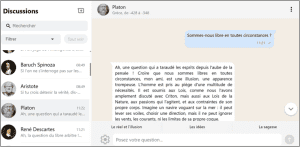
This is the interface for PhiloGPT, inspired by Whatsapp, is very easy to read and is immediately adopted by everyone.
To work on essay methodology, Vincent Mirebeau suggests another application, Methodophilo, in which ChatGPT is used to evaluate productions. Before using it, it is advisable to look at the video which explains how it works. For a subject, the application begins by asking you to identify the concepts and then define them. Then you have to construct the problem. Help is provided on how to do this. You then construct a plan in two or three parts before starting to write. Templates are provided, as well as practice exercises to work on the specific elements of the essay, from the hook to the opening, with the option of having each exercise assessed by the tutor. Other exercises provide practice in philosophy: fill-in-the-blank texts, reconstructing texts, identifying logical connectors, defining concepts, determining a thesis. The tutorial section provides methodological support. While the assessment does not replace that of a teacher – proposed by ChatGPT – it must be considered critically and sometimes repeated, the activities proposed are very useful for preparing for the philosophy baccalaureate.


All use cases

"Explore our full range of use cases—click below to learn more!"