Creating a song to learn a lesson

Offering musical versions of learning content helps pupils who struggle with memorisation through reading. Transforming text into music boosts attention, motivation and engagement. When students help create the songs, they strengthen digital skills, practise using generative AI, and learn to evaluate and refine AI outputs while exploring diverse musical styles and cross‑curricular projects.

Any category of learner, depending on the situation.

Music AI can be used in a number of contexts.

Initial and continuous VET (as in our example)
– Transform technical content (recipes, procedures, hygiene standards, safety instructions) into songs to make it easier to remember.
– Joint project between several subjects (e.g. cooking + music + English = creation of an educational video).
– Use the music generated as a cue or background sound in an educational escape game.

Classic disciplinary context
– Language lessons: write and sing a song in English or Spanish.
– Literature lessons: setting a poem or text to music.
– Science lessons: turn formulas or definitions into refrains for better retention.

Create songs or music for open days, school events or graduation ceremonies.

Turning a technical lesson (sauce recipes) into a song makes the concepts more fun and memorable for some learners. Pupils who have difficulty with written notes or pure rote memorisation benefit from an auditory and rhythmic approach.

Learners discover that academic content can be transformed into fun songs, which may changes the way they relate to learning. The original and unexpected aspect may strengthens commitment.

Generative AI makes it easy for teachers and non-musical students to create compositions. It can generate material adapted to different levels: simplified versions for beginners, enriched versions for advanced learners.

A generative AI to propose the text to be set to music.An AI song and music generator (some sites also offer to create the lyrics).

1. Quality and accuracy of content
Since AI can generate technical errors (e.g. a step incorrectly described in a recipe or a mix-up in proportions), the teacher must check the text to be memorised.
2. Loss of personal creativity
If teachers or students rely solely on AI, there is a risk that they will simply consume rather than create. AI becomes a “shortcut” that replaces the effort of imagination, instead of inspiring it.
5. Technological dependence
Regular use of AI can lead to dependency: difficulty in producing without assistance.
There is a risk that students will believe that they cannot be creative without a digital tool.

Objectives

Offer an educational alternative to pupils who have difficulties memorising through reading.
Stimulate learners’ attention by varying formats (text → music) and increase commitment and motivation through a fun and original approach.

If learners are involved in the process, they can improve their use of generative AI digital tools (text + music) and develop the ability to select, adapt and improve an AI production.

Example of implementation

The first step is to identify the theme to be set to music. Let’s take the example of a cookery teacher who wants to offer his students a musical version of the recipes for the four main sauces (béchamel, velouté, espagnole and hollandaise).

Next, ask any generative AI for lyrics with a prompt like :

“I’m a cookery teacher at a vocational college. My students have trouble remembering the recipes for the four main sauces: béchamel, velouté, espagnole and hollandaise. I need a song to remind them of each of these recipes.”

Once the AI has suggested lyrics and you’ve approved them, you’ll need to set them to music.

There are many sites where you can create music. Here suno.com was used.
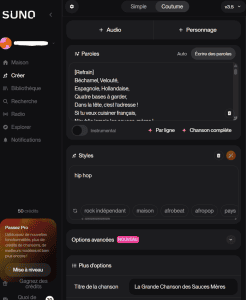
All you have to do is follow the guide, copy and paste your lyrics and choose a musical style. The result is amazing!

Here is the French version:

And the English version:

Another possibility is to get the learners more involved by inviting them to create a song themselves to help them remember something they’re having trouble remembering.

They can explore several styles (classical, rap, electro, jazz), experiment with musical styles from all over the world (Afrobeat, flamenco, k-pop) and compare the results. They can work together, each proposing a feature (lyrics, rhythm, theme) to the AI, who will assemble them.

They can also participate in ncross-disciplinary projects: writing a song in language lessons, composing a soundtrack for an educational escape game, setting to music a poem studied in literature.

All use cases

"Explore our full range of use cases—click below to learn more!"